Cube vs Barrel Sauna: Which Should You Buy?
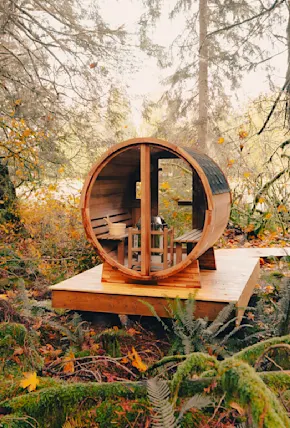
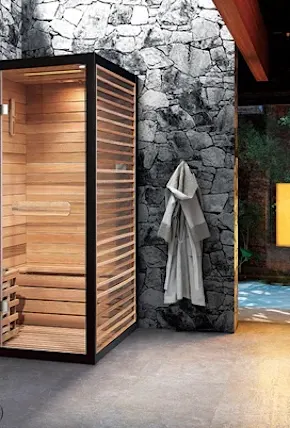
This guide will help you answer this question. But the TL;DR version is, it depends on several things: heat bathing style, heat source, and layout. A cube sauna is better for those who prefer tiered benches with the option to sit higher for more intense heat or lower for less heat. It’s also an aesthetic choice, with cubes often offering a more contemporary style. A barrel sauna is better for those who like a consistent temperature throughout the sauna and a single bench height. Barrels also heat up faster with natural convection. Design-wise, the barrel has a more rustic, traditional look. Nootka Saunas, the Squamish, BC-based builder we consulted for this guide, hand-crafts both styles from western red cedar and ships throughout the USA and Canada.
Read on to dive in deeper and develop a better understanding of what all that means below.
Barrel vs. Cube Sauna at a Glance
Shape
- Barrel: Cylindrical, organic form
- Cube: Modern take on the Finnish cabin
Heat Character
- Barrel: Consistent temperature via continuous convection current
- Cube: Stratified heat with hotter air up top, gentler below
Benches
- Barrel: Single height
- Cube: Two-tier, choose your intensity
Heat-up Time
- Barrel: 15-20 minutes
- Cube: 20-25 minutes
Heat Source
- Barrel: Electric heater or woodburning stove
- Cube: Typically electric heater only
Capacity:
- Barrel: 4-6 adults (depending on model size)
- Cube: 3-6 adults (depending on model size)
Best For:
- Barrel: Fast heat-up, even heat, wood-fired option, blending into an outdoor setting
- Cube: Traditional Finnish sauna experience, tiered heat options, contemporary architectural look
What is the Difference Between a Cube and Barrel Sauna?
A cube sauna is a contemporary take on the traditional Finnish cabin-style sauna that blends together the rounded edges of a barrel sauna with the classic cabin shape for a modern look. The higher ceiling of a cube sauna makes it possible to house two bench heights for a more distinct stratification—or layers—of heat. This way, sauna users have two options: sit up high for more intense sweat or stick to the lower bench for a softer, gentler warmth.
The barrel sauna has a cylindrical shape designed for continuous convection flow in which air is constantly being recirculated. Since it doesn’t have corners, there’s no chance of cold air pockets, which is good news for those who want an efficient sauna that heats up fast. The barrel sauna is a nice-looking organic design, with a form that is more complementary to an outdoor setting rather than overpowering. Depending on your sightline and surroundings, a common add-on feature is a tinted glass window for sauna sits with a view.
“We will often see that people are between the two,” said Kris Harris, co-founder of Nootka Saunas, which crafts handmade saunas in Squamish, BC. As a former mechanical engineer and lifelong sauna user, Harris brings extensive knowledge and years of experience to Nootka that makes him an expert in sauna building, but also a trusted source on the art of heat bathing.
“Some sauna purists insist your feet need to be above the heater rocks. We don't strictly subscribe to that, but the cube sauna allows you to take the first few sessions on the higher bench and gradually make your way down to the lower bench for less heat,” said Harris. “By no means is the barrel sauna secondary to the cube. A well-designed barrel sauna is a different animal because it heats up really quickly and you’re not wasting any room on top with corners, so they get a really nice convection current through them.”
The difference maker often comes down to the layout of your outdoor space, like the sightlines, or existing architecture which may or may not compete with something like a cube’s linear roof and be better balanced by the barrel’s unique shape. All these deciding factors play a role in your final choice, but when it comes to sauna, it’s always the heat that matters most.