Fuji GA645Zi Review: The Best Medium Format Camera (That's Perfect for IG)

Fuji GA645Zi Review: The Best Medium Format Camera (That's Perfect for IG)

Author Photographer
  • Christie Fitzpatrick

A pro film photographer's take on the 1998 medium format camera that quietly outperforms cameras twice its size and price—with one major drawback

Published: 04-16-2026

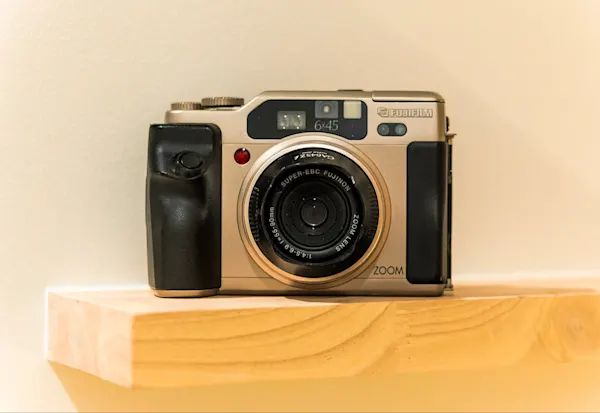
The Fujifilm GA645Zi is an enigma. It's a medium format camera that looks like a 35mm camera that ate too much at the buffet, with an image aspect ratio that straddles both formats. It's the Suzuki Jimny of the camera world. Released in 1998 as the final and most fully-featured model in Fuji's GA645 series, the GA645Zi is a 6x4.5 medium format autofocus point-and-shoot with a built-in zoom lens, pop-up flash, motorized film advance, and enough automation that you could hand it to a stranger for a family photo without too much worry.

By 1998 standards, the GA645Zi's user-friendly nature was a bit of a novelty—medium format cameras weren't exactly known for being easy or practical to use. By today's standards, it's still a novelty, because nothing quite like it has been made since. The camera is a favorite film camera among the Field Mag fam—I've been shooting mine for a few years now and I know its features inside and out.

Below, I'll break down all the pros, cons, and quirks of the Fujifilm GA645. And explain why I've considered (and reconsidered) selling it, but why I ultimately always keep it in rotation.
Fujifilm GA645Zi-thumbnail

Fujifilm GA645Zi

Shop at eBay
  • Format 120/220 roll film, 6×4.5 (56×41.5mm)
  • Lens Super-EBC Fujinon 55–90mm f/4.5–6.9 (stepped zoom: 55/65/75/90mm)
  • Shutter 2 seconds – 1/700 + Bulb, electronic inter-lens leaf shutter
  • Autofocus Hybrid active/passive IR, 1m to infinity
  • Metering Center-weighted TTF (through the finder)
  • ISO 25–1600
  • Shooting Modes Program (P), Aperture Priority (A), Slow Sync (AS), Manual (M)

Pros:

  • Travel-sized
  • Aperture priority and portrait mode
  • Sharp-as-a-knife lens
  • Viewfinder tells you everything

Cons:

  • Autofocus lets you down often
  • Slow lens
  • Stepped zoom takes getting used to
  • Size
  • Needs to be loaded carefully
  • Portrait mode can be tricky

Fujifilm GA645 Series: A Brief History

Fuji's GA645 line arrived in 1995 and did something pretty unusual for the time period: it took the ergonomic logic of a 35mm point-and-shoot and scaled it up to shoot 120 film. The original GA645 and the wide-angle GA645W both featured fixed prime lenses—a 60mm f/4 and 45mm f/4, respectively—and had basic automation. The second generation, the GA645i and GA645Wi, arrived in 1997 with a few improvements. Then in 1998, Fuji released the GA645Zi, the zoom model which closed out the series, and the model this article focuses on.

The "Z" in the name stands for zoom. Where the earlier cameras offered single fixed focal lengths, the Zi brought a 55–90mm zoom lens (equivalent to roughly 34–56mm in 35mm terms). It's not a continuous zoom, but a stepped one, snapping to four fixed focal lengths: 55, 65, 75, and 90mm.

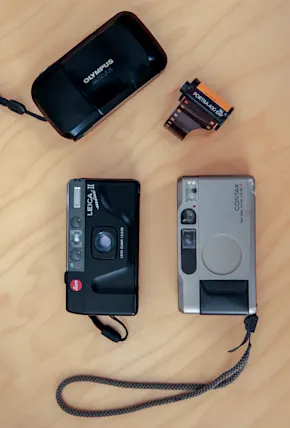
The update also added a viewfinder diopter adjustment, a lens cap sensor, improved ergonomics, and a quieter autofocus motor. The black version came out a year after the standard champagne/titanium colorway and is considerably harder to find. I really like the champagne color that I have, and I have to say it looks pretty nice on the shelf alongside an Mju ii and an old Contax G1.

As with most of history’s greatest film cameras, none of these cameras are being produced anymore, but used copies circulate regularly on sites like eBay and KEH. Prices have risen steadily as medium format film has gone increasingly mainstream, but the GA645Zi remains much more accessible than, say, a Mamiya 7ii or a Plaubel Makina 67.
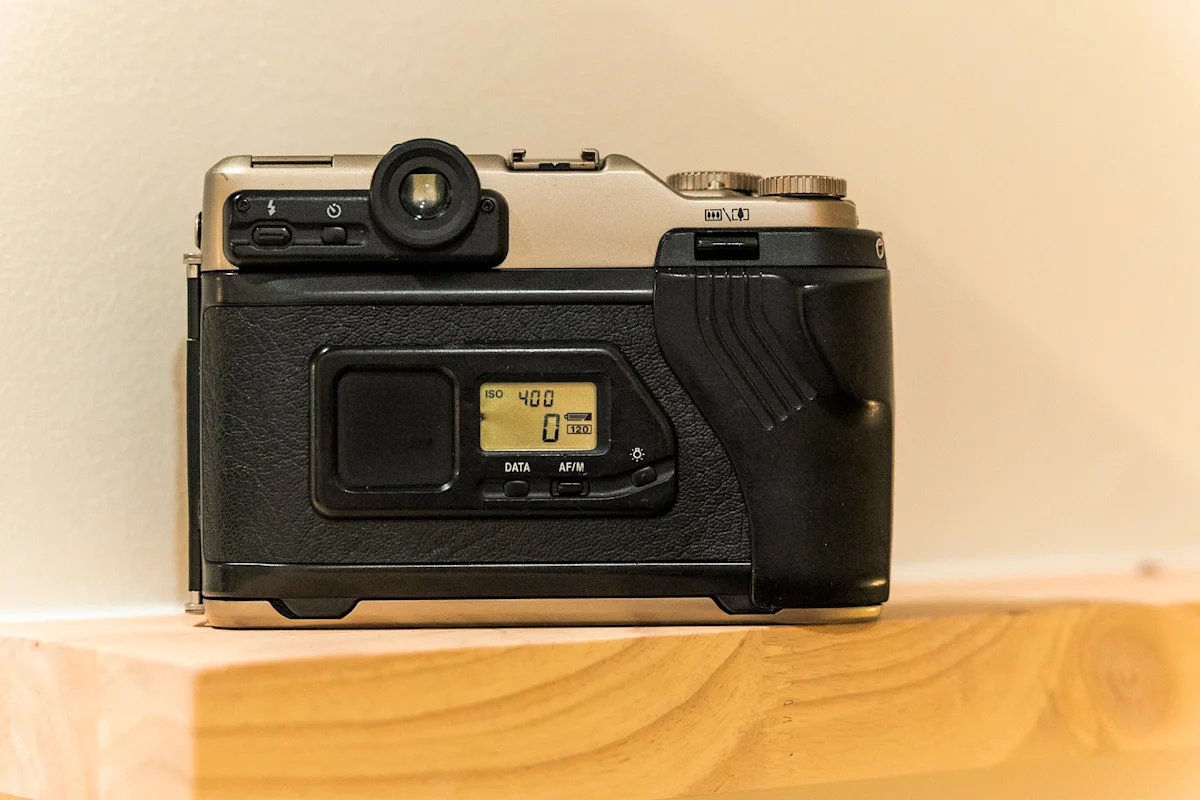
christie-fitzpatrick-fuji-ga645zi-rear

Specs, Design & Ergonomics

The GA645Zi shoots 120 or 220 film in 6x4.5 format (technically 56x41.5mm), giving you 15 frames on a roll of 120. That negative is about 2.7 times the surface area of a 35mm frame. It's not as large as 6x7, but it’s still a decent step up.

The body is plastic with titanium cladding on the front, top, and base. The camera feels more substantial than it sounds, though I wouldn't call it rugged or indestructible. It is, after all, plastic, and if you drop it, there’s going to be heartbreak. If you’re a medium format shooter already, you’ll find it light and portable weighing in under a kilogram. If you’re a 35mm shooter looking to trade up, you’ll think it’s absurdly shaped and sized - boxy and huge, like a square shaped cyclops. Either way, it's remarkably light for what it delivers.

One design decision that surprises (and delights) every first-time user is that the camera shoots portrait orientation by default and has a portrait orientation viewfinder to boot. It’s a bit strange at first, as you hold it the same orientation as you would a normal landscape-shooting camera, it feels like your field of view is quite narrow compared to a wider viewfinder, but you get used to it. This was an intentional choice by Fuji, and it makes a lot of sense given that the GA645Zi is well-suited to subject-led documentary work and environmental portraits. That said, it takes a while to stop fighting the urge to rotate the camera.

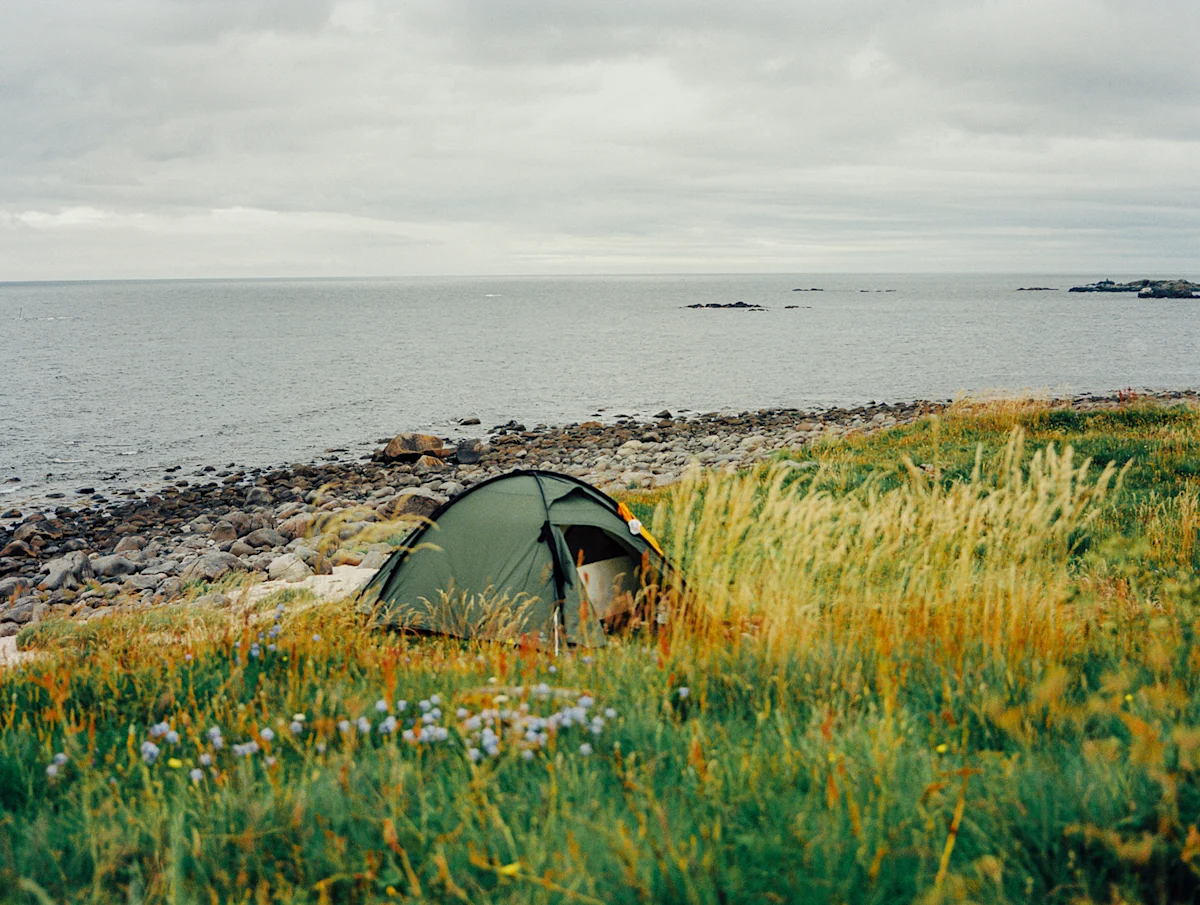
christie-fitzpatrick-fujiGA645-review-waterfront-tent

Fujifilm GA645Zi Hands-On Review

What's Good About the Fujifilm GA645Zi

It's a travel-sized medium format

The main reason to love the GA645Zi is for its medium format image quality in a (relatively) compact design. For a medium format camera, its portability is hard to beat. Compared to a Mamiya Rb67 or Hasselblad, this thing is practically pocketable. I've taken mine on overnight ski tours, on bikepacking trips, and into the backcountry without significantly changing how I packed my bag. That's something you can't say about nearly every other camera shooting this negative size.

Aperture priority and portrait mode are all you need

The center-weighted meter is reliable, and the ±3 stop exposure compensation gives you good control when you need it. Aperture priority mode is where I spend most of my time; it's intuitive and covers the majority of situations. The portrait orientation is more than a novelty—I genuinely enjoy it. It suits portraits, tall mountain verticals, and anything where you want negative space above and below your subject.

The lens is sharp as a knife

The Super-EBC Fujinon lens is sharp across the zoom range with excellent contrast and minimal flare. Film loading is a methodical and easy experience too—Fuji's push-out spool pegs are intuitive and fast, just like loading a point and shoot. The motorized film advance between frames is quiet enough and noticeably faster than manually winding through a rangefinder.

The viewfinder tells you everything

The viewfinder is bright, informative, and has a diopter adjustment, which makes a big difference for anyone who shoots while wearing glasses. The frame lines shift automatically as you zoom and focus, which keeps framing accurate at close distances. You also get shutter speed, aperture, and focus confirmation displayed in-finder, which is more information than you'd expect from a camera this old and automated.

It's a toy camera that means business

Overall, when shooting well-lit scenes, it produces gorgeous images and it is a joy to use. It has a playful quality, kind of like shooting with a toy camera, and whilst it may seem like a bit of a caricature, there's no doubt the GA645Zi is an exceptionally capable machine.

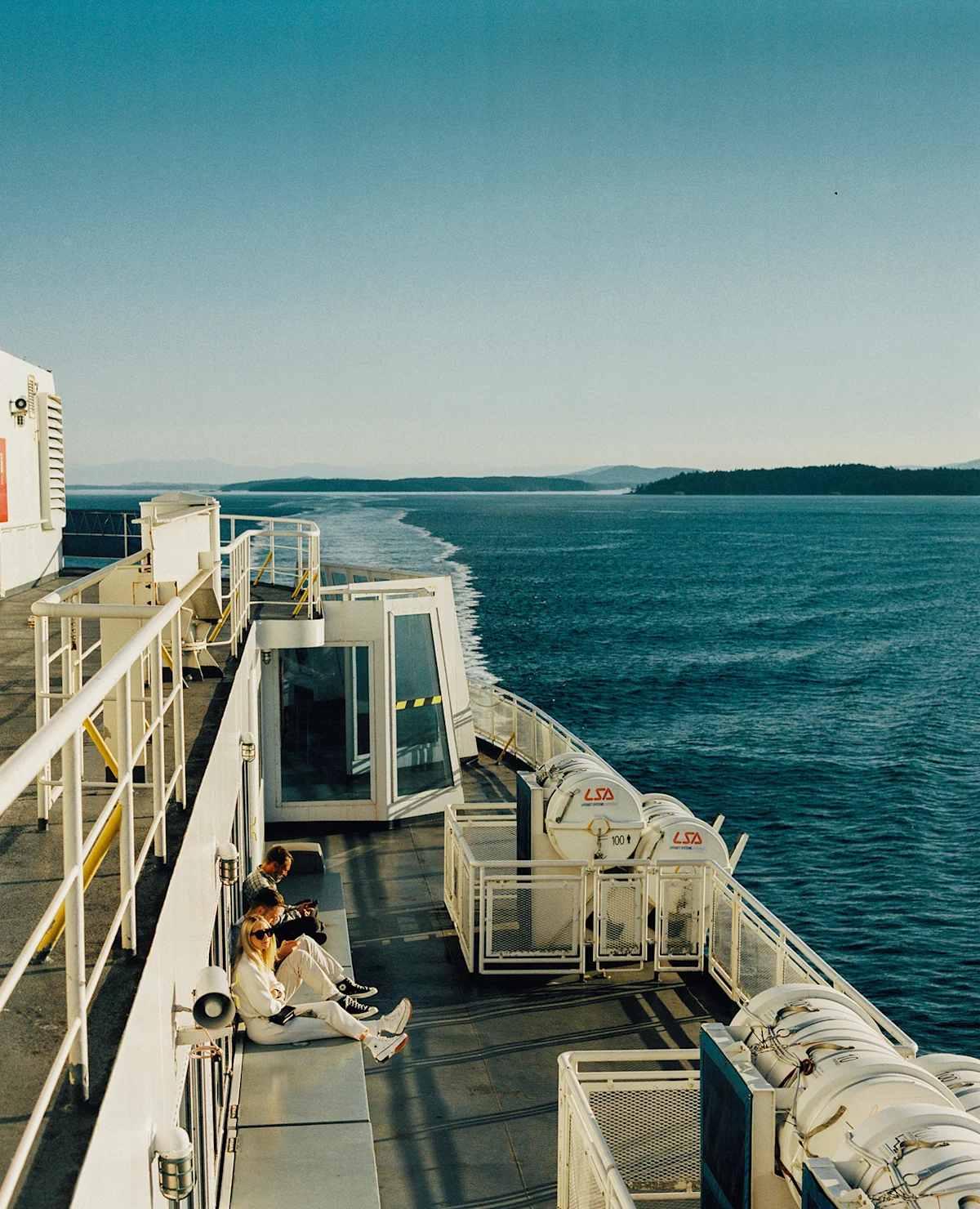
christie-fitzpatrick-fujiGA645-review-boat

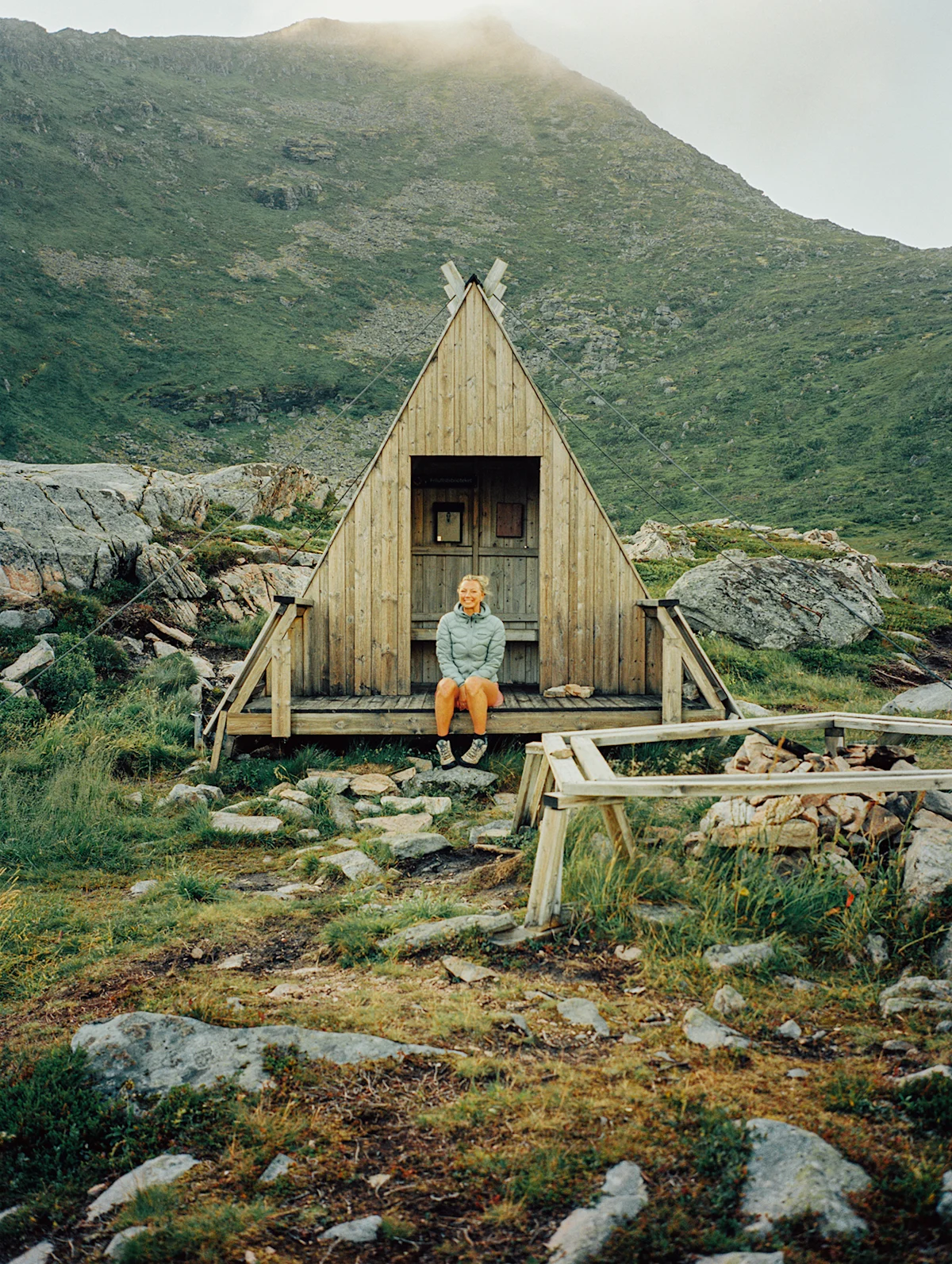
christie-fitzpatrick-fujiGA645-review-aframe

What's Not So Good About the Fujifilm GA645Zi

The autofocus will reliably let you down

The autofocus is the 645zi's major downfall. Its performance tanks in low contrast and low light. Fuji’s “hybrid/passive” system is good, but it's flawed, and in light conditions encountered on overcast days or in shaded forests, it's likely to hit or miss. Manual focus is available via the command dial, but it's hard to use and fiddly—too fiddly to want to use too often. For slow, considered moments like intimate portraits, you’d be better off with a camera built for the cause, like a Hasselblad or Pentax 67.

The slow lens is a real tradeoff

There’s no getting around it, the lens is slow. At f/4.5 on the wide end and f/6.9 at 90mm, you're not going to get great performance in low light without flash or high-ISO film. Compared to the fixed-lens GA645 with its f/4 prime, the zoom flexibility definitely comes at a cost.

The stepped zoom takes some getting used to

Speaking of zoom, the mechanism here is stepped, not continuous. It snaps to 55, 65, 75, or 90mm. It's less awkward than it sounds in practice, but it takes some getting used to and requires moving your feet as much as the zoom button if you want to frame a photo just right. For most field shooting situations this isn't a dealbreaker, but it is a quirk to be aware of.

It's compact for medium format, not compact for a camera

While it isn’t a tank like most medium format cameras, the GA645Zi isn't small either. It fits in your bag the way a sandwich fits in your pocket—technically yes, but everyone knows you're packing PB&J. That said, for a medium format camera, the portability is genuinely hard to beat. If true pocketability and shooting medium are your priority, you’d probably get better value out of a Holga 120.

Load it carefully or pay the price

Film loading, while intuitive, can easily produce a "fat roll" if the start line isn't precisely aligned with the arrows before you close the back. This is when the roll winds loose, becoming susceptible to light leaks. It's a known issue with the GA645 series and requires a bit of patience until you've got the feel for it.

Portrait mode is a trap as much as a feature

Back to the portrait orientation, as it’s both a pro and a con. It's fun, but shooting on it, I sometimes fall into the trap of framing for Instagram rather than just composing the image for the scene in front of me.

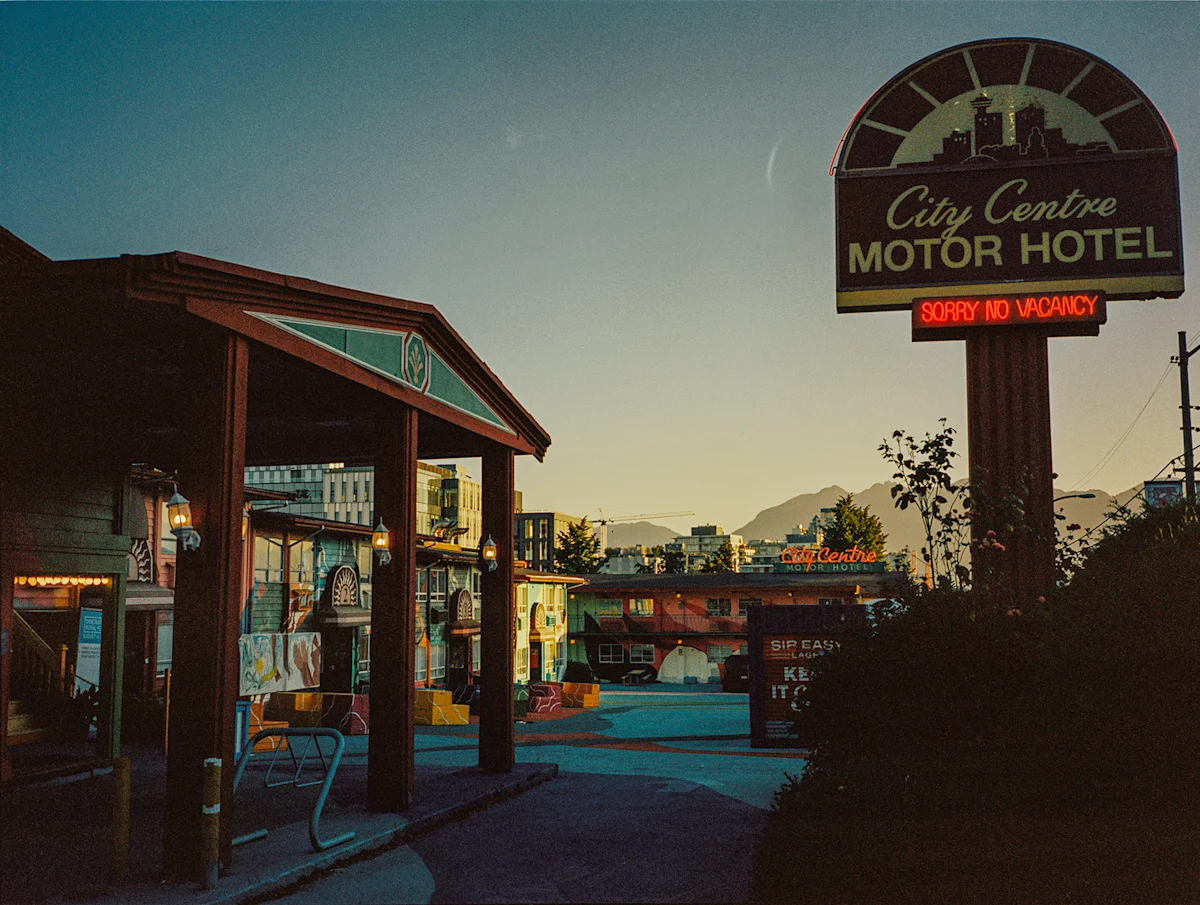
christie-fitzpatrick-fujiGA645-review-motel

Issues to Look Out For When Buying a Fujifilm GA645Zi

The most important thing to check before buying a GA645Zi is the rear LCD screen. It is this camera's Achilles heel (a cautionary tale for smaller point-and-shoots too). The screen is connected to the main body via a ribbon cable embedded in the film door hinge, a pretty vulnerable position, and when they break, so does the screen. Rumor has it replacement ribbons can only be found in person, in China. A broken LCD makes it difficult or impossible to confirm ISO, shooting mode, and exposure settings.

Fuji no longer supports these cameras for repair, and the companies that used to service them on Fuji's behalf have largely wound down. For serious shooters, a working LCD is non-negotiable. Beyond that, check the usual stuff: battery door integrity, rust on hinges and connectors, and run through the zoom toggle to confirm all four focal lengths engage cleanly.

Prices vary considerably depending on condition, whether you're buying from a specialist seller or private sale, and by which color. The black version commands a premium and is genuinely harder to find, even though I think the champagne looks better. Expect to pay around $1,200 for a fully working specimen with a clean LCD. It's worth it over a cheaper body with a compromised screen.

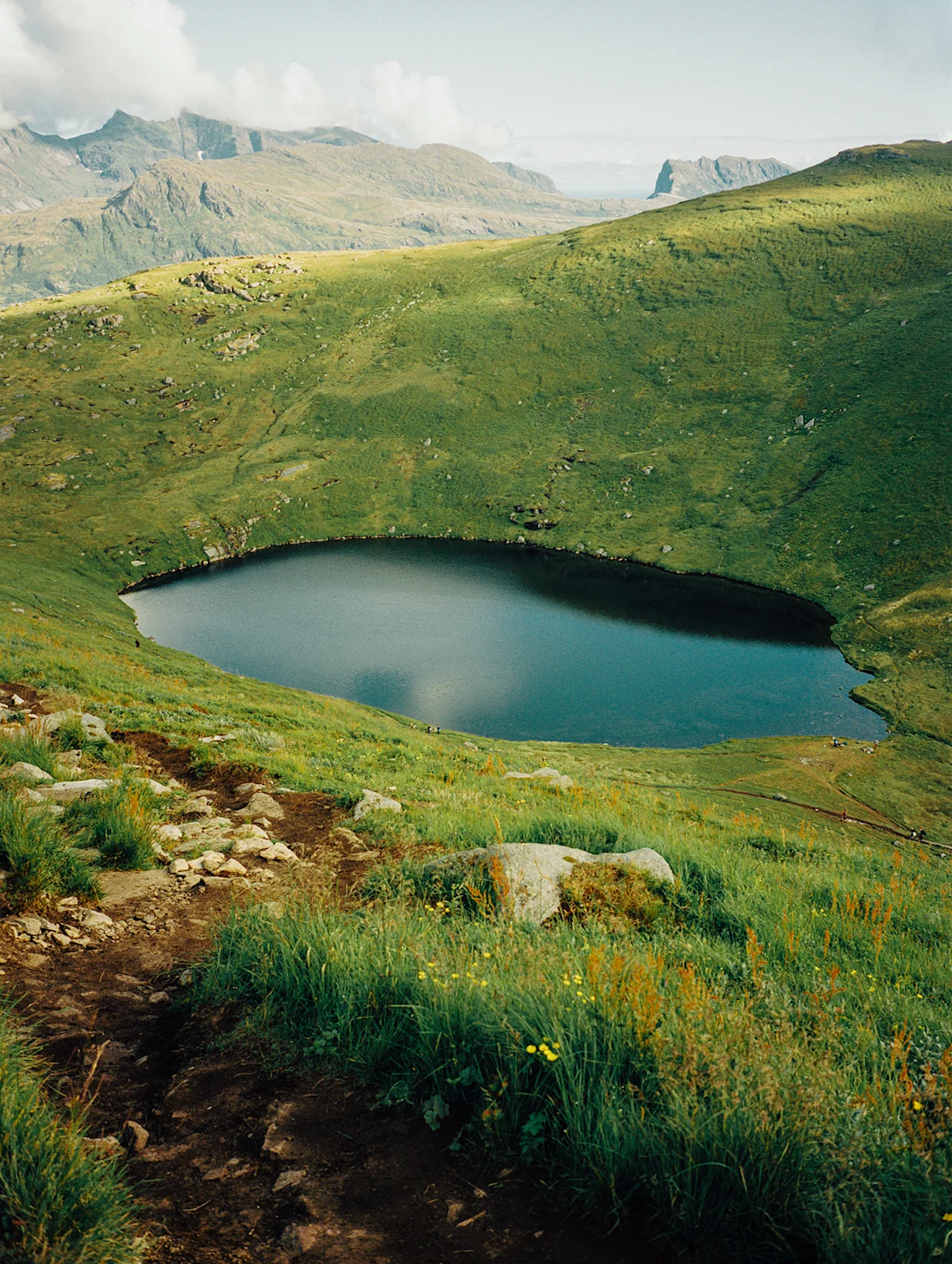
christie-fitzpatrick-fujiGA645-review-mountain-lake

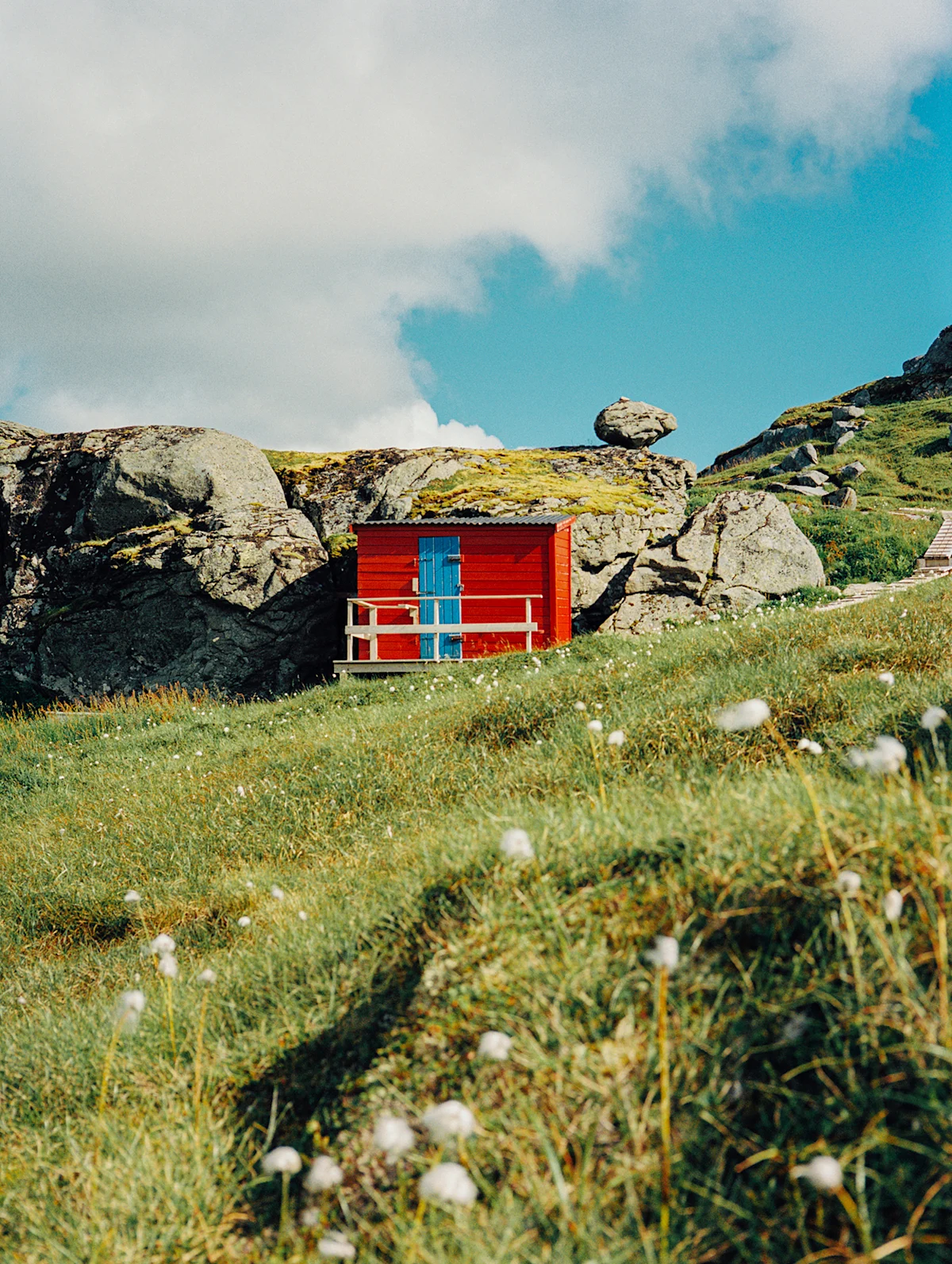
christie-fitzpatrick-fujiGA645-review-red-cabin

Final Verdict: Is the Fujifilm GA645Zi Worth Buying?

If you've been shooting 35mm for a while and find yourself wanting more from your negatives without committing to a mechanical medium format system, the GA645Zi is one of the most compelling entry points available. It shoots beautiful negatives, has excellent ergonomics, and asks very little of you technically.

Is it a camera I trust when shooting campaigns for clients? Not exactly. I'll bring it along, but I always accept the possibility that the focus might miss. It's sort of like staying in a relationship with a guy knowing he might cheat on you one day, or have a second family hidden in the Hamptons. Not exactly a relationship built on mutual trust.

I use my GA645Zi as a giant point-and-shoot. Any landscapes that I'd shoot on my Mju ii, I'd shoot on the 645Zi. I don't use it often, but when I do, and when I shoot within those parameters, it produces results that outperform what I'd get from an equivalent 35mm setup (which is to be expected for 2.7x the negative size), and it does so in a really good-looking, portable package.

That said, it's limited to situations drenched in light, since the slow lens is a real limitation in a lot of scenarios. The autofocus issues and the slow lens are the main reason I almost sold it—and I came close. What stopped me was the camera's negative quality; when it works, it really works. The results simply don't have an equivalent at this size and portability. If the GA645zi stopped down to f2 and had a better autofocus system, it'd be my dream camera.

Is the Fujifilm GA645Zi a perfect camera? Far from it. The autofocus will disappoint you, the portrait orientation will have landscape photographers cursing their wrist dexterity, and since it's electronic, it will one day kick the bucket and that'll be that. But for a certain type of photographer, that combination of good UX, medium format quality, and genuine portability is hard to find elsewhere.

Shop on eBay

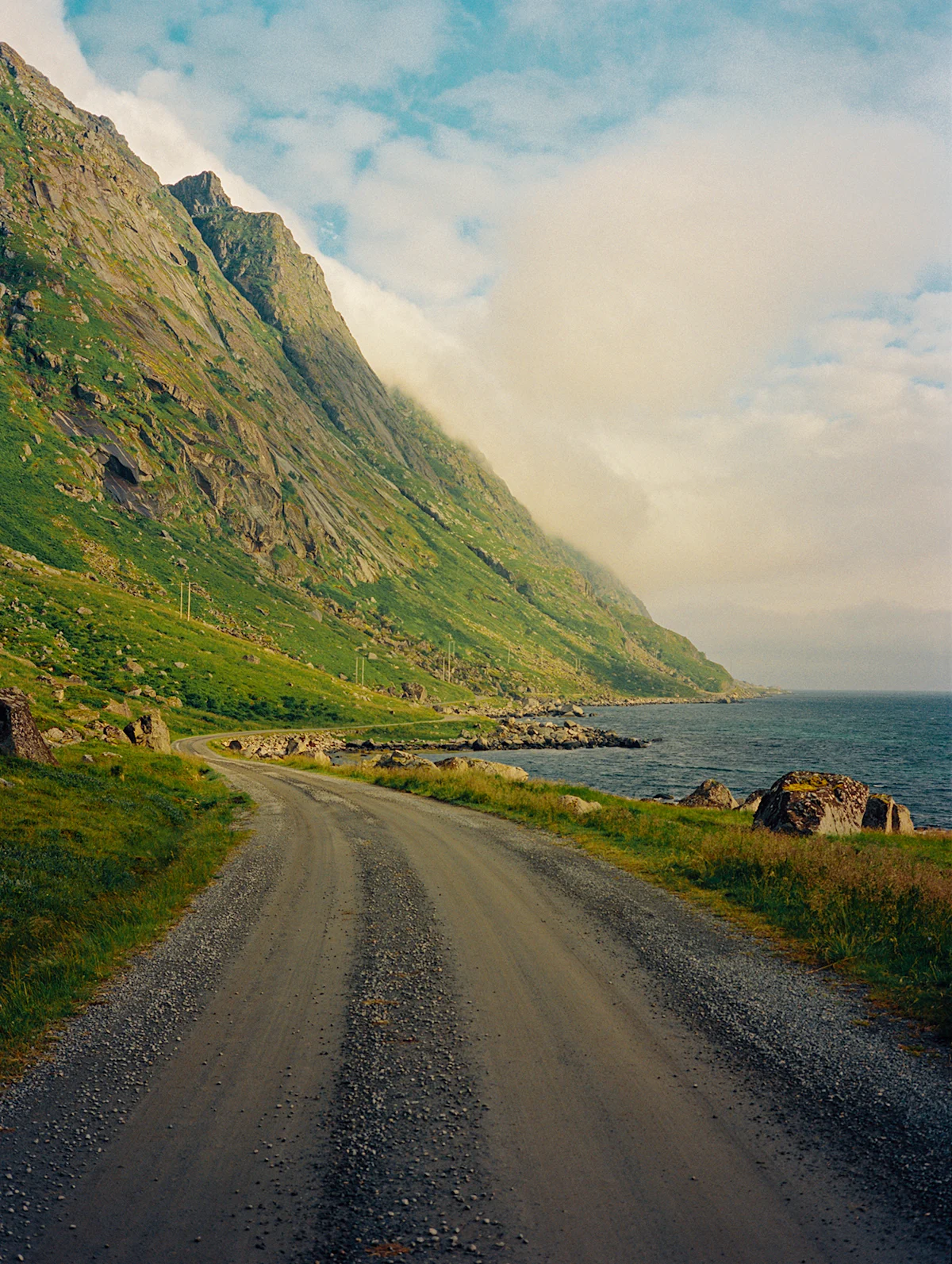
christie-fitzpatrick-fujiGA645-review-seaside-road

christie-fitzpatrick-fujiGA645-review-aerial-landscape-2

Check out our guide to the best medium format cameras for more recs.